A Deep Learning and Attention Mechanism-Based Multiclass Computer-Aided Diagnosis Study for Moyamoya Disease, Arteriovenous Malformations, and Cerebral Aneurysms
Cerebrovascular disease classification from magnetic resonance imaging (MRI) is an important task in medical image analysis. This study focuses on using deep learning techniques to automatically classify three cerebrovascular diseases, including Moyamoya Disease (MMD), Arteriovenous Malformation (AVM), and Cerebral Aneurysm (CA), based on T2-weighted MRI images. Multiple deep learning architectures are evaluated, including convolutional neural network (CNN) models such as VGG16, ResNet18, ResNet34, and DenseNet121, as well as Vision Transformer-based models including ViT, PiT, and Swin Transformer V2. In addition, Squeeze-and-Excitation (SE) and Convolutional Block Attention Module (CBAM) are integrated with CNN models to improve the recognition of subtle vascular features.
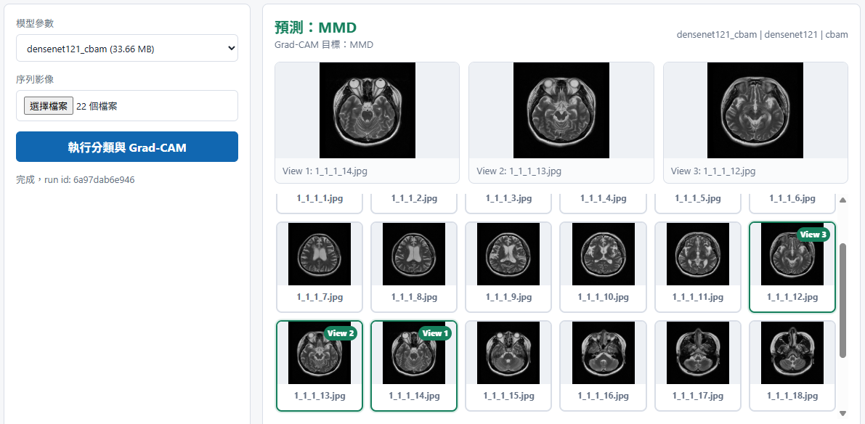
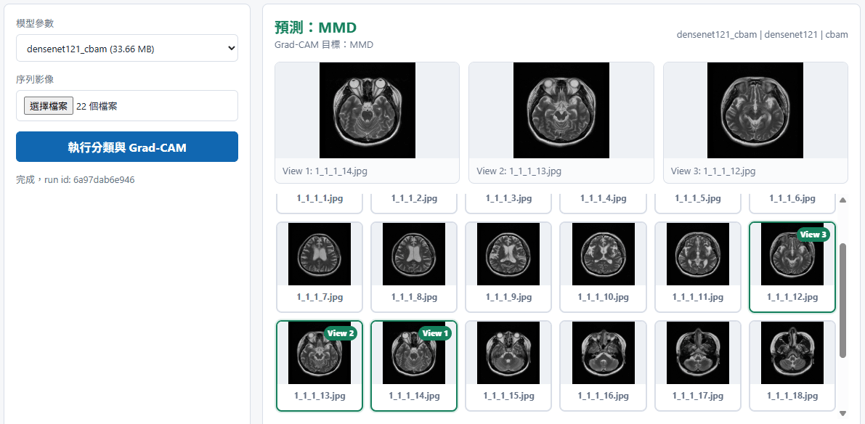
The proposed approach uses three consecutive T2-weighted MRI slices as an image group to preserve spatial information between adjacent slices and better reflect the clinical image-reading process. To address the limited number of cases commonly encountered in rare disease studies, data augmentation is applied to increase image diversity and improve model robustness. The classification performance of different models is evaluated using accuracy, recall, precision, F1-score, and area under the receiver operating characteristic curve (AUC). Grad-CAM is further employed to visualize the image regions that contribute to model predictions and to examine whether the learned features correspond to clinically meaningful vascular structures.
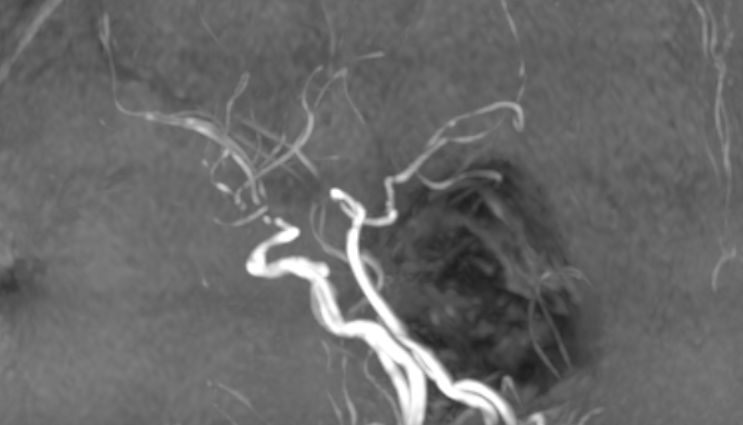
The experimental results show that data augmentation improves the classification performance of all evaluated models, while CNN models combined with attention mechanisms achieve better overall performance under the small-sample setting. Among all models, DenseNet121 combined with CBAM achieves the best performance, with an overall classification accuracy of 92.6% and an MMD recall of 88.9%. Grad-CAM visualization further demonstrates that the model mainly focuses on clinically relevant vascular regions, including internal carotid artery narrowing, reduced or absent middle cerebral artery signals, and moyamoya collateral vessels. These findings indicate that the proposed framework has the potential to support the development of computer-assisted diagnosis systems for rare cerebrovascular diseases and provide a reference for future medical imaging research using artificial intelligence.