Automatic Thyroid Nodule Detection, Segmentation, and Classification in Ultrasound Images Based on Deep Learning
Thyroid nodules are common endocrine abnormalities, and their detection has increased with the widespread use of high-resolution ultrasound. However, ultrasound images are often affected by noise, low image contrast, and differences in diagnostic experience, which may lead to inconsistent assessments of benign and malignant nodules. This study focuses on developing a deep learning–based computer-aided diagnosis framework to improve the objectivity and efficiency of thyroid nodule analysis.
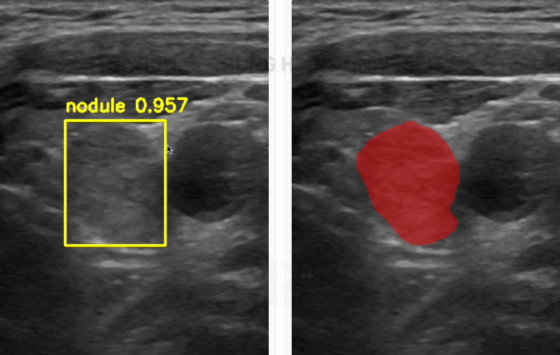
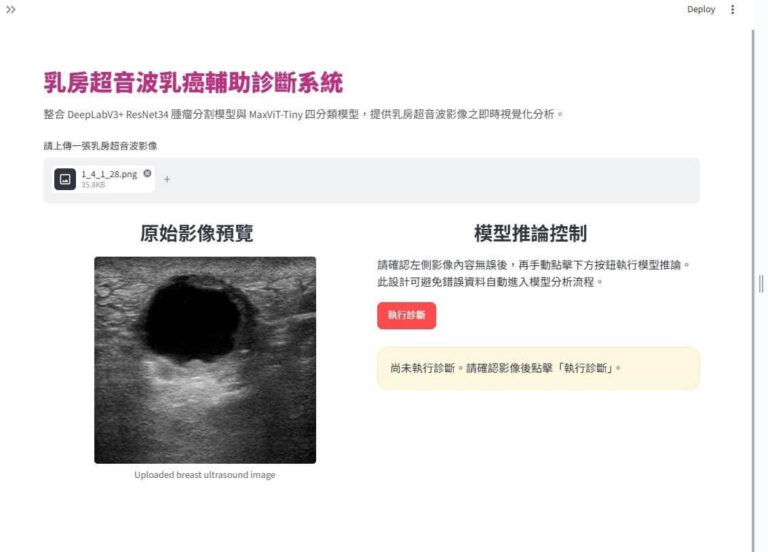
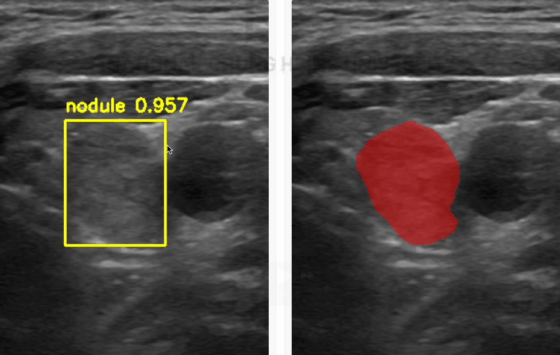
The proposed framework integrates three major tasks: nodule detection, image segmentation, and benign–malignant classification. YOLO-based models, including YOLOv8, YOLOv11, and YOLOv26, are evaluated for automatically locating and segmenting thyroid nodules. For classification, multiple deep learning architectures are compared, including convolutional neural networks (CNNs), Transformer-based models, and hybrid CNN–Transformer models.
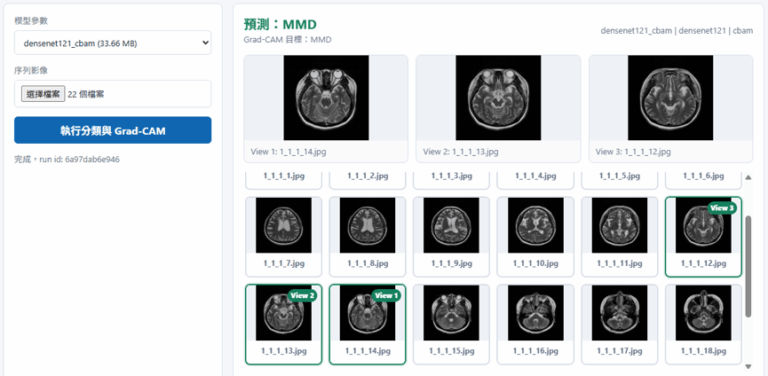
The study utilizes thyroid ultrasound images obtained from the Taiwan Biobank and publicly available datasets. Different data configurations and augmentation strategies are investigated to address data imbalance and improve model robustness. Model interpretability is also explored using visualization techniques to examine whether the classification models focus on clinically relevant nodule regions.
Experimental results demonstrate the effectiveness of the proposed framework. Transformer-based models achieved the best benign–malignant classification performance, with an accuracy and F1-score of 0.90 and an AUC of 0.96. For nodule detection, the augmented YOLOv11 model achieved an mAP@50 of 0.995 and mAP@50:95 of 0.841, while YOLOv8 achieved the best segmentation performance with an mAP@50 of 0.995 and mAP@50:95 of 0.723.
By integrating detection, segmentation, and classification into a multi-stage deep learning framework, this research provides an automated approach for analyzing thyroid ultrasound images. The proposed system demonstrates the potential of artificial intelligence to assist clinicians in identifying thyroid nodules, understanding their boundaries, and assessing malignancy risk, contributing to the development of more efficient and reliable computer-aided diagnosis systems.